
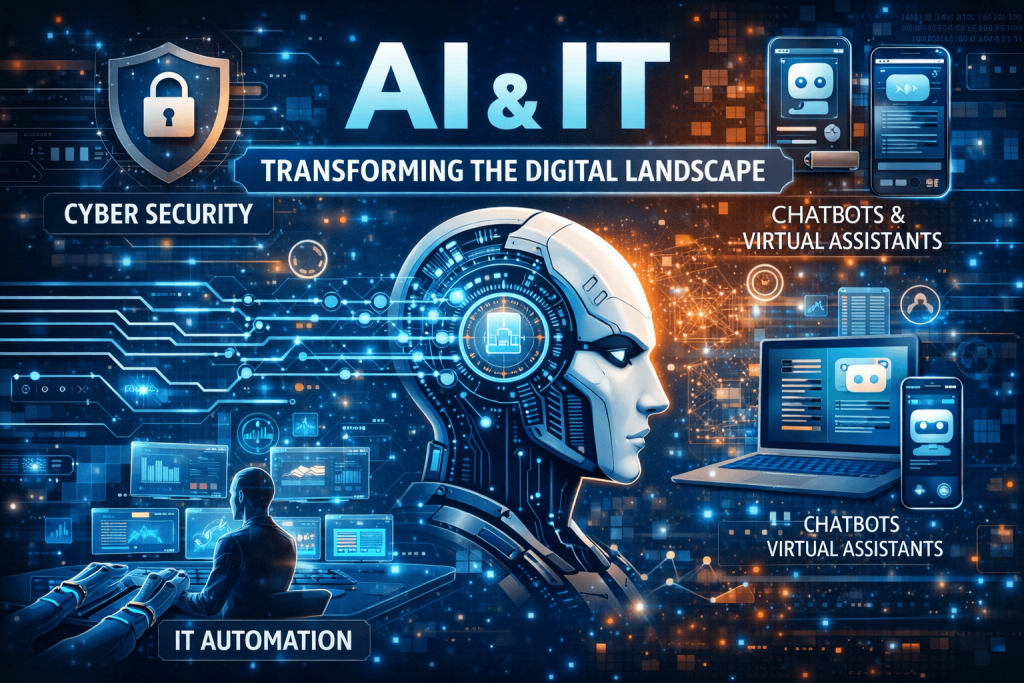
The Role of Artificial Intelligence in Modern IT: Transforming the Digital Landscape
Introduction
Artificial Intelligence (AI) is no longer a futuristic concept—it is a core component of modern Information Technology (IT). From automating routine tasks to enabling intelligent decision-making, AI is redefining how businesses operate in the digital era.
As organizations increasingly adopt AI-driven solutions, understanding its role in IT becomes essential for staying competitive and innovative.
What is AI in IT?
AI in IT refers to the integration of intelligent algorithms and machine learning models into IT systems to automate processes, analyze data, and improve system performance.
These systems can:
- Learn from data
- Adapt to new inputs
- Perform tasks that typically require human intelligence
Key Applications of AI in IT
1. IT Automation
AI-powered automation is streamlining IT operations by reducing manual intervention.
Examples:
- Automated server management
- Self-healing systems
- Intelligent monitoring tools
2. Cybersecurity Enhancement
AI plays a critical role in detecting and preventing cyber threats in real time.
Capabilities:
- Identifying unusual patterns
- Predicting potential attacks
- Responding instantly to security breaches
3. Data Analytics and Insights
AI enables businesses to process massive amounts of data and extract actionable insights.
Benefits:
- Faster decision-making
- Predictive analytics
- Improved business strategies
4. AI in Cloud Computing
Cloud platforms are increasingly integrating AI to offer smarter services.
Use Cases:
- AI-powered storage optimization
- Intelligent resource allocation
- Automated scaling
5. Chatbots and Virtual Assistants
AI-driven chatbots are transforming customer support and user interaction.
Advantages:
- 24/7 availability
- Instant responses
- Reduced operational costs
Emerging Trends in AI and IT
Edge AI
Processing data closer to the source (devices) instead of centralized servers improves speed and reduces latency.
AIOps (Artificial Intelligence for IT Operations)
AIOps uses AI to enhance IT operations by automating issue detection and resolution.
Generative AI
Tools like AI content generators and code assistants are revolutionizing development workflows.
Business Impact of AI in IT
1. Increased Efficiency
Automation reduces workload and improves productivity across IT departments.
2. Cost Reduction
AI minimizes operational costs by optimizing resources and reducing errors.
3. Better Decision-Making
Data-driven insights help businesses make smarter and faster decisions.
4. Competitive Advantage
Companies using AI gain a significant edge over competitors.
Challenges of Implementing AI in IT
Despite its benefits, AI adoption comes with challenges:
- High initial investment
- Data privacy concerns
- Lack of skilled professionals
- Integration with existing systems
Future of AI in IT
The future of AI in IT is promising, with advancements in deep learning, natural language processing, and automation expected to drive innovation further.
AI will continue to:
- Enhance cybersecurity
- Improve software development
- Enable smarter infrastructures
Conclusion
Artificial Intelligence is transforming the IT industry at every level. Businesses that leverage AI effectively can improve efficiency, reduce costs, and deliver superior user experiences.
Adopting AI is no longer an option—it is a necessity for organizations aiming to thrive in the digital age.