
1B+ Downloads, One Cue Stick: What 8 Ball Pool Teaches Us About Building a Mobile Games Business
How Miniclip turned a simple pool game into one of the biggest mobile gaming businesses in history—and what entrepreneurs can learn from it.
The biggest businesses in mobile gaming aren’t always built on the most complex ideas.
Sometimes they’re built around a single mechanic that people never get tired of playing.
That’s exactly what happened with 8 Ball Pool by Miniclip.
At first glance, it looks like a simple digital version of pool. Under the surface, however, it’s one of the most refined free-to-play businesses ever created—combining a carefully balanced virtual economy, live events, competitive matchmaking, and monetization systems that have generated hundreds of millions of dollars over more than a decade.
For developers, entrepreneurs, and product builders, 8 Ball Pool isn’t just a successful game—it’s a masterclass in building a long-lasting mobile business.
Let’s break down exactly why.
8 Ball Pool by the Numbers
Before diving into the business model, it’s worth understanding just how massive the game has become.
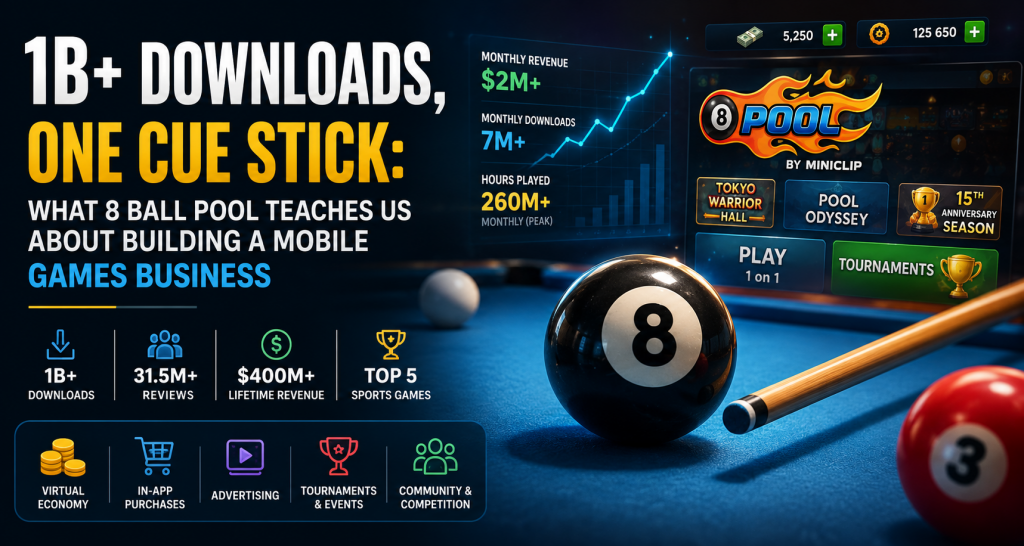
Google Play Statistics
- 1B+ Android downloads
- 4.7★ rating
- 31.5+ million reviews
- Ranked among the Top Grossing Sports Games on Google Play
- Free-to-play with:
- In-app purchases
- Randomized (loot-box style) items
- Advertisements
The game originally launched as a browser title in 2008 before arriving on mobile in 2013.
More than 17 years later, it’s still generating millions in monthly revenue.
Very few mobile games achieve that level of longevity.
A Revenue Story Most Games Never Reach
The financial history of 8 Ball Pool is even more impressive.
Some notable milestones include:
- Approximately $400 million in lifetime revenue by 2018
- More than 52% of revenue came from the United States
- Best recorded month:
- January 2017
- Over $17 million across iOS and Android
- Recent Sensor Tower estimates still place the game around:
- $2M monthly U.S. revenue
- 7M monthly downloads
This is the key takeaway:
The biggest opportunity in mobile gaming isn’t launching a viral hit. It’s building a game people continue playing for years.
The Mobile Gaming Market in 2026
Understanding 8 Ball Pool becomes easier when you look at today’s mobile gaming industry.
Current industry estimates show:
- Global mobile gaming revenue:
$126–134 billion annually - In-app purchase revenue:
Approximately $81.75 billion - 96–99% of all mobile game downloads are free-to-play
- Industry downloads declined roughly 7.2% in 2025
- Only 5–10% of players ever spend money
This tells us something important.
The market is no longer driven by explosive download growth.
Instead, successful studios focus on:
- Increasing retention
- Improving monetization
- Keeping players engaged for years
That’s exactly where 8 Ball Pool excels.
The Business Model Behind 8 Ball Pool
Although the game appears simple, its monetization strategy is highly sophisticated.
Instead of relying on one revenue source, it combines multiple systems.
1. Dual Virtual Currency
Players use:
- Coins for entering matches
- Cash as premium currency
Coins constantly move through the economy:
Players wager them…
Win them…
Lose them…
Then eventually purchase more.
This creates an economy that never stops moving.
2. In-App Purchases
The game sells:
- Premium currency
- Cue upgrades
- Cosmetic items
- Special rewards
- Randomized reward boxes
Rather than selling power directly, it encourages progression and collection.
3. Advertising
Most players never spend money.
Advertisements monetize those players while they continue increasing matchmaking quality and overall community size.
Free players still generate value.
4. Cosmetic Progression
Status matters in competitive games.
Players purchase:
- Premium cues
- Exclusive tables
- Avatars
- Seasonal cosmetics
These purchases don’t necessarily make players better—but they make them stand out.
5. Seasonal Events
Instead of releasing a game and walking away, Miniclip continuously launches:
- New tournaments
- Anniversary seasons
- Limited-time events
- Reward streaks
- Fresh progression systems
This keeps players returning every week.
6. Skill Mixed With Randomness
One reason the audience remains so broad is that the game blends:
- Genuine aiming skill
- Cue control
- Strategic positioning
with
- Random rewards
- Lucky spins
- Scratch cards
- Event drops
That combination keeps casual players engaged while still rewarding experienced players.
Why This Business Model Works
At its core, 8 Ball Pool uses a PvP wagering economy.
Players risk virtual currency to enter matches.
Winning earns more currency.
Losing drains resources.
Eventually, players purchase premium currency to continue progressing.
Psychologically, this creates a powerful gameplay loop:
Play → Win → Earn → Upgrade → Risk More → Repeat
It’s simple.
But incredibly effective.
What It Would Take to Build a Competitor Today
Many developers wonder:
“Could I build the next 8 Ball Pool?”
Technically?
Yes.
Commercially?
That’s much harder.
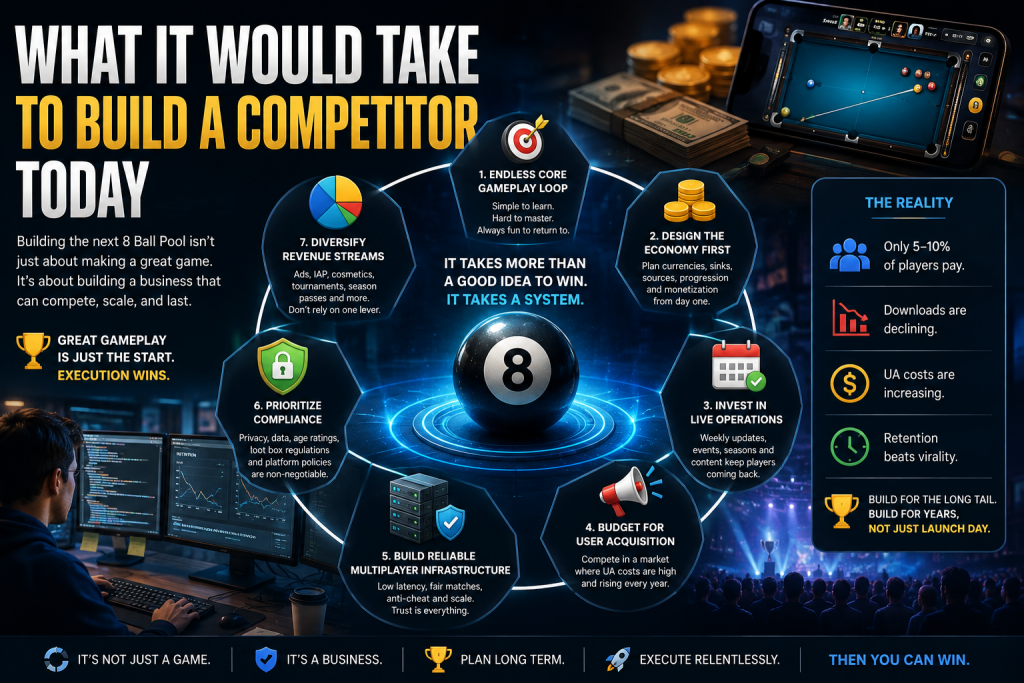
Here’s what you’d actually need.
1. Create an Endless Core Gameplay Loop
The gameplay itself isn’t complicated.
Matches last only a few minutes.
Controls are intuitive.
Anyone can understand the objective within seconds.
That accessibility is one of the game’s biggest strengths.
2. Design the Economy First
Many developers build gameplay first and monetization later.
Successful free-to-play studios do the opposite.
You must design:
- Currency sinks
- Currency sources
- Rewards
- Progression
- Match entry fees
- Premium currency flow
before adding content.
The economy is the product.
3. Invest in Live Operations
Launching the game is only the beginning.
Competitive mobile games require:
- Weekly updates
- Seasonal content
- Events
- New cosmetics
- Community management
- Analytics
- Balance adjustments
This requires an ongoing team—not a one-time development effort.
4. Budget for User Acquisition
Building a good game isn’t enough.
Players have to discover it.
Industry estimates suggest mobile game publishers spent roughly $25 billion on user acquisition in 2025.
Advertising costs continue rising.
Organic growth alone is rarely sufficient.
5. Build Reliable Multiplayer Infrastructure
PvP games depend on trust.
Players expect:
- Fast matchmaking
- Low latency
- Stable servers
- Anti-cheat protection
- Fair competition
Technical reliability becomes part of the product itself.
6. Prioritize Compliance
Modern mobile games must also consider:
- Privacy regulations
- Data collection policies
- App Store compliance
- Loot-box regulations
- Age ratings
These aren’t legal details to solve later.
They’re product decisions from day one.
7. Diversify Revenue Streams
The strongest gaming businesses don’t depend on a single monetization strategy.
8 Ball Pool combines:
- Ads
- Premium currency
- Cosmetics
- Seasonal content
- Tournament entry
- Randomized rewards
If one revenue stream weakens, others continue supporting the business.
What Success Really Looks Like
There are several lessons entrepreneurs often overlook.
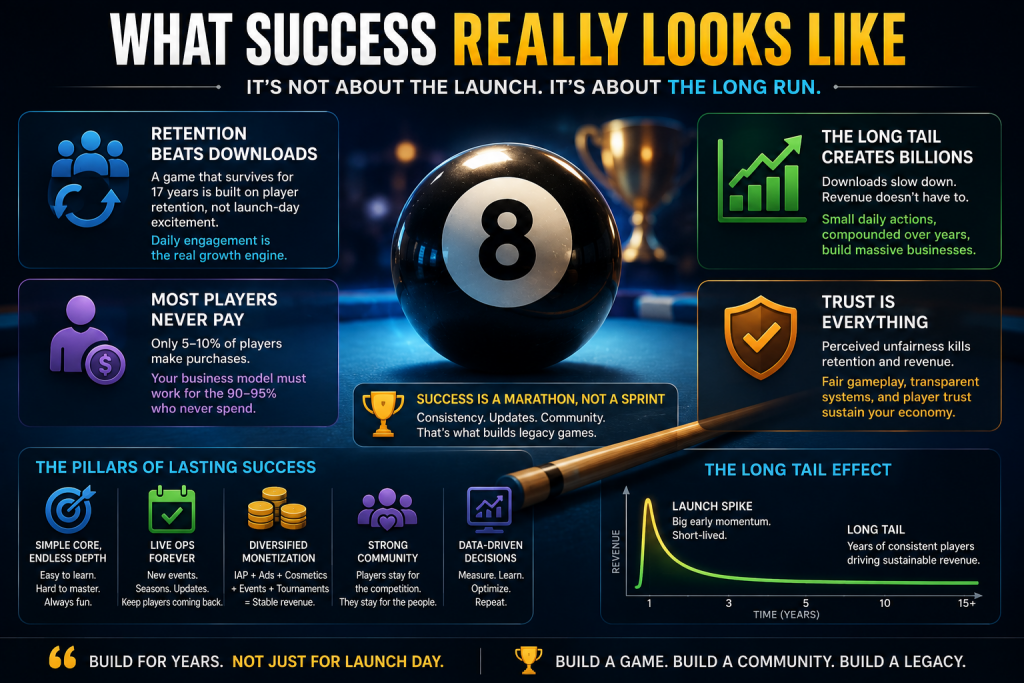
Retention Beats Downloads
A game that survives for 17 years is built on player retention—not launch-day excitement.
Daily engagement matters far more than viral growth.
The Long Tail Creates Billion-Dollar Businesses
Downloads eventually slow.
Revenue doesn’t have to.
If players continue returning every day, the business can remain highly profitable for years.
Most Players Never Pay
Only 5–10% of players typically purchase anything.
That means your business model must work even when 90–95% of users never spend money.
Design accordingly.
Trust Matters
Competitive games always face accusations of unfairness.
Whether it’s matchmaking, luck, or reward systems, players must believe the game is fair.
Once trust disappears, monetization becomes much harder.
Lessons Every Product Builder Can Learn
Even if you’re not building a mobile game, 8 Ball Pool offers valuable lessons:
- Keep the core product extremely simple.
- Build systems that encourage users to return daily.
- Treat retention as the most important metric.
- Design monetization around long-term engagement rather than short-term revenue.
- Continue improving the product long after launch.
- Diversify revenue sources instead of relying on a single one.
These principles apply just as much to SaaS products, marketplaces, and social apps as they do to games.
Final Thoughts
8 Ball Pool wasn’t the first digital pool game.
It simply executed better than almost everyone else.
Its success comes from combining an accessible gameplay loop with a carefully engineered virtual economy, years of live operations, continuous content updates, and multiple monetization systems that compound over time.
For entrepreneurs considering the mobile gaming industry, the real questions aren’t:
- Can I build a pool game?
They’re:
- Can I build an economy players stay in for years?
- Can I fund live operations long after launch?
- Can I compete against incumbents with billions of installs?
- Can I build a business where only 1 in 10 players ever pays?
Those are the questions that determine whether a game becomes another forgotten release—or the next decade-long success story.